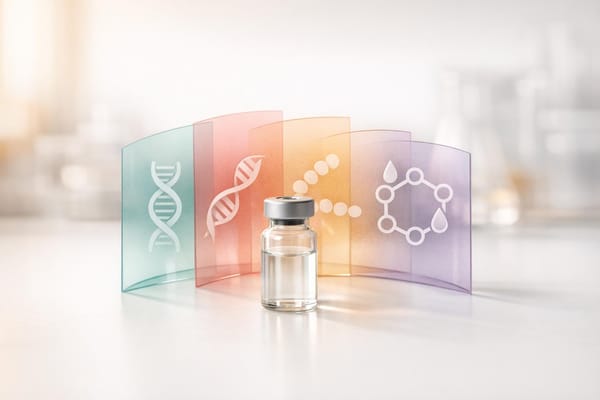
Three Treatment Paths — How RareLabs Tests Multiple Approaches at Once

When a family comes to RareLabs, one of the first things we explain is this: we don't put all our eggs in one basket. Rare disease research is inherently uncertain — no one can predict in advance which approach will yield the most promising results for any given condition. That's why we pursue multiple treatment strategies simultaneously, because casting a wider net gives families the best chance of finding something that works.
This parallel approach is one of the things that sets RareLabs apart from traditional research programs, which typically focus on a single therapeutic modality and follow it through years of sequential development. We believe that for families facing rare disease, time is too precious for a single-track strategy.
Here's how our three treatment paths work — and why we believe in pursuing them together.
Path 1: Drug Repurposing — Finding New Uses for Existing Medicines
Drug repurposing (also called drug repositioning) is the strategy of testing drugs that are already approved by the FDA for other conditions to see if they might also be effective against a rare disease. This approach has several compelling advantages.
First, these drugs have already been through extensive safety testing. Their side effect profiles are well understood, their dosing has been established, and in many cases, they're already available by prescription. This means that if a repurposed drug shows promise in the laboratory, the path from bench to bedside can be dramatically shorter than for a brand-new drug.
Second, the sheer number of available candidates makes this approach powerful. There are approximately 3,000 FDA-approved drugs on the market today, spanning virtually every therapeutic category. Using high-throughput automated screening systems, RareLabs can test these drugs against your personalized disease model in a matter of weeks — a process that would take years if done manually.
Here's how it works in practice: once your personalized disease cells and assay are ready (from Phase 1), we load thousands of compounds into automated screening plates. Robotic systems apply each drug to your disease cells at multiple concentrations, and sophisticated imaging and analysis software measures the response. The result is a ranked list of compounds that show the most promising activity against your specific disease phenotype.
The most promising "hits" then undergo secondary validation — additional testing at different concentrations and time points to confirm the initial results. Compounds that pass this stage become candidates for further discussion with your medical team about potential clinical use.
Drug repurposing is often the fastest and most cost-effective of our three paths. It's not guaranteed to find a winner — but when it does, the results can be actionable quickly.
Path 2: ASO Therapy — Precision Molecules That Target Your Gene
Antisense oligonucleotides (ASOs) represent one of the most exciting frontiers in rare disease treatment. These are short, synthetic molecules — typically 15 to 25 nucleotides long — that are designed to bind directly to a specific sequence of RNA in your cells. By doing so, they can modulate gene expression in precise, targeted ways.
Depending on the nature of the genetic defect, an ASO can be designed to accomplish different goals. It can silence a gene that's producing a toxic protein. It can restore production of a protein that's missing or deficient. It can correct the way your body reads a genetic instruction — for example, by causing cells to skip over a mutated section of a gene (a technique called exon skipping).
The power of ASO therapy lies in its specificity. Each ASO is designed for a particular genetic sequence, making it possible to create truly personalized treatments — even for conditions where only a single patient in the world carries a specific mutation.
At RareLabs, we can design and test up to 50 different ASO candidates for a single condition. Our process involves computational design of candidate sequences, synthesis of the ASOs, and systematic testing in your personalized disease cells to identify which candidates show the strongest therapeutic effect. The most promising ASOs are then further optimized for potency, specificity, and stability.
Several ASO-based drugs have already received FDA approval for rare diseases, including nusinersen (Spinraza) for spinal muscular atrophy and eteplirsen (Exondys 51) for Duchenne muscular dystrophy. These precedents demonstrate that the regulatory pathway for ASO therapies is established and that the approach can translate from laboratory to clinic.
Path 3: Gene Therapy — Addressing the Root Cause
Gene therapy takes the most direct approach to genetic disease: rather than working around the genetic defect, it aims to fix it. This can mean inserting a healthy copy of the defective gene into a patient's cells, or in some cases, directly repairing the mutation using gene editing tools.
The most common delivery method for gene therapy uses adeno-associated viruses (AAVs) — small, non-pathogenic viruses that have been engineered to carry therapeutic genetic material into target cells. AAV-based gene therapies have shown remarkable results in several rare diseases, with some patients experiencing sustained benefit from a single treatment.
Gene therapy offers the potential for long-lasting or even permanent therapeutic effects — a particularly meaningful prospect for genetic conditions that would otherwise require lifelong treatment. However, it's important to understand that gene therapy development typically requires more time and investment than drug repurposing or ASO therapy. The design, production, and testing of gene therapy vectors is a complex process, and the regulatory pathway, while increasingly well-defined, involves rigorous safety evaluation.
At RareLabs, gene therapy is part of our parallel strategy. While drug repurposing and ASO screening may yield results more quickly, gene therapy development proceeds alongside these efforts so that no time is lost. If gene therapy emerges as the most promising path for your condition, the groundwork will already be in place.
Why Parallel Matters
The traditional approach to rare disease research is sequential: pick one strategy, pursue it for years, and if it doesn't work, start over with another. For families, this means potentially waiting a decade or more before learning that a particular approach isn't going to help.
Our parallel approach changes this equation fundamentally. By pursuing drug repurposing, ASO therapy, and gene therapy simultaneously, we maximize the probability of finding something that works — and we minimize the time families spend waiting for answers.
Not every family will need all three paths. The right combination depends on the specific condition, the nature of the genetic mutation, and the family's goals and circumstances. Our team works with each family to develop a customized research plan, and we're transparent at every stage about what we're learning, what it costs, and what it means.
Honest Answers, Clear Results
We want to be direct about something: not every path will lead to a treatment. Some approaches will show promise; others will help us rule out options. Both outcomes are valuable, because every answer brings a family closer to clarity about what's possible.
We may not have all the answers yet. But we will give you honest, clear results — what might work and what won't — so you can make the best decisions for your family.
We allow science to lead.